
by Rose Lugo, Ed.D.
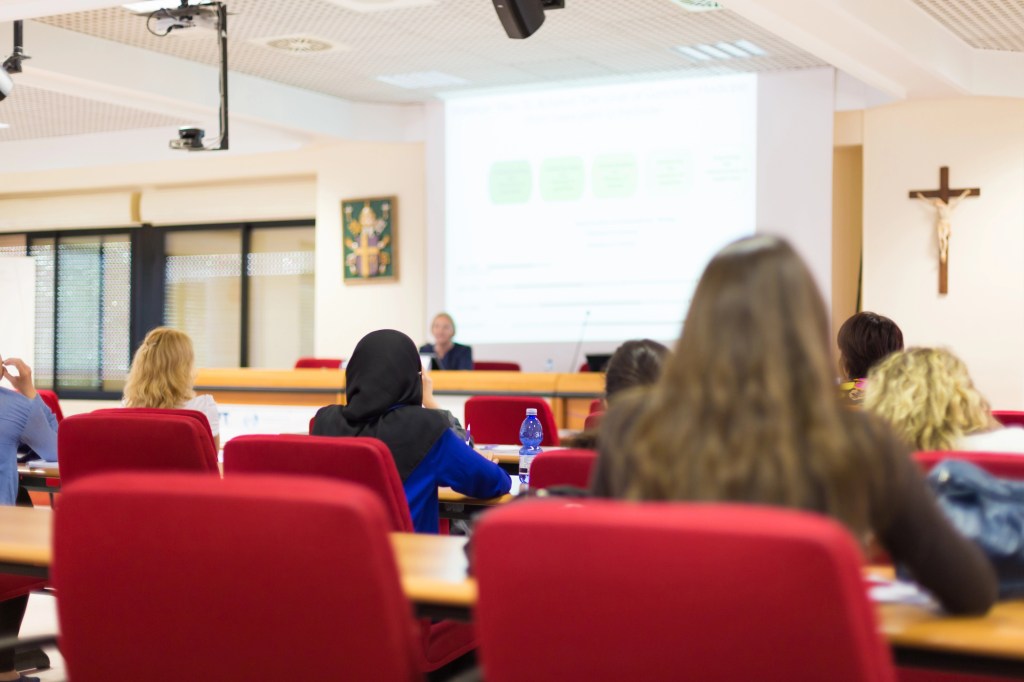
During my observations at the Saint Gabriel Media Literacy Institute—pseudonym used to protect research subjects—I witnessed a classroom of schoolteachers from different grades and disciplines, from private and public education, learning about the fundamentals of media literacy. The topics ranged from personal media consumption habits, conglomerate control of the media market, message construct, iconography, image composition, editing strategies, digital channel tactics, and much more. These lessons came along with unraveling the teachings of the Church. An intriguing dynamic, in which teachers explored the connections between media literacy and Catholic social teaching.
One pivotal segment about Globalization uncovered scholarly insights on consumerism, while also providing a concise review of Catholic social teaching by introducing concepts like common good and solidarity. In this context, media education emerged as a powerful tool to address social justice concerns, equipping students with essential media literacy knowledge and a direct link to Christian faith and values. The training encouraged participants to critically assess media messages through a Catholic Social Teaching lens, fostering discussions on dominant ideologies prevalent in American television and blockbuster movies, for example.
Further delving into Catholic social teaching, the training emphasized the rights and responsibilities of individuals, drawing from the Catechism of the Catholic Church to highlight human rights and civil duties. The Preferential Option for the Poor and Vulnerable guided discussions on the mainstream media’s portrayal of marginalized groups, prompting teachers to analyze media messages critically, considering the perspectives of workers, fostering awareness of social and economic inequalities perpetuated by mainstream media.
As part of a teacher professional development program, this training prepares teachers to bring back to their classrooms tangible teaching strategies for students to discern values portrayed in mainstream media messages in light of Gospel teachings through reflection and group discussions. Teachers are also encouraged to empower students to respond by creating their own media content, providing feedback to media producers, advocating for social issues, volunteering, or taking other meaningful actions.
References to scriptures and Church documents reinforced the importance of advocating for the common good, transcending religious boundaries to address universal social justice concerns. Character education is one of the main learning outcomes of this teaching model, given that students are prompted to actively respond to media messages through solidarity and social activism.
In essence, the training at the Saint Gabriel Media Literacy Institute not only honed teachers’ media literacy skills but also by using Church teaching as a framework to deconstruct mainstream media messages and create media messages informed by faith values in response, it is meant to instill in students a sense of social responsibility, and solidarity. Catholic Social Teaching is a prolific framework in this exercise.
T
 Rose Lugo, Ed.D.